
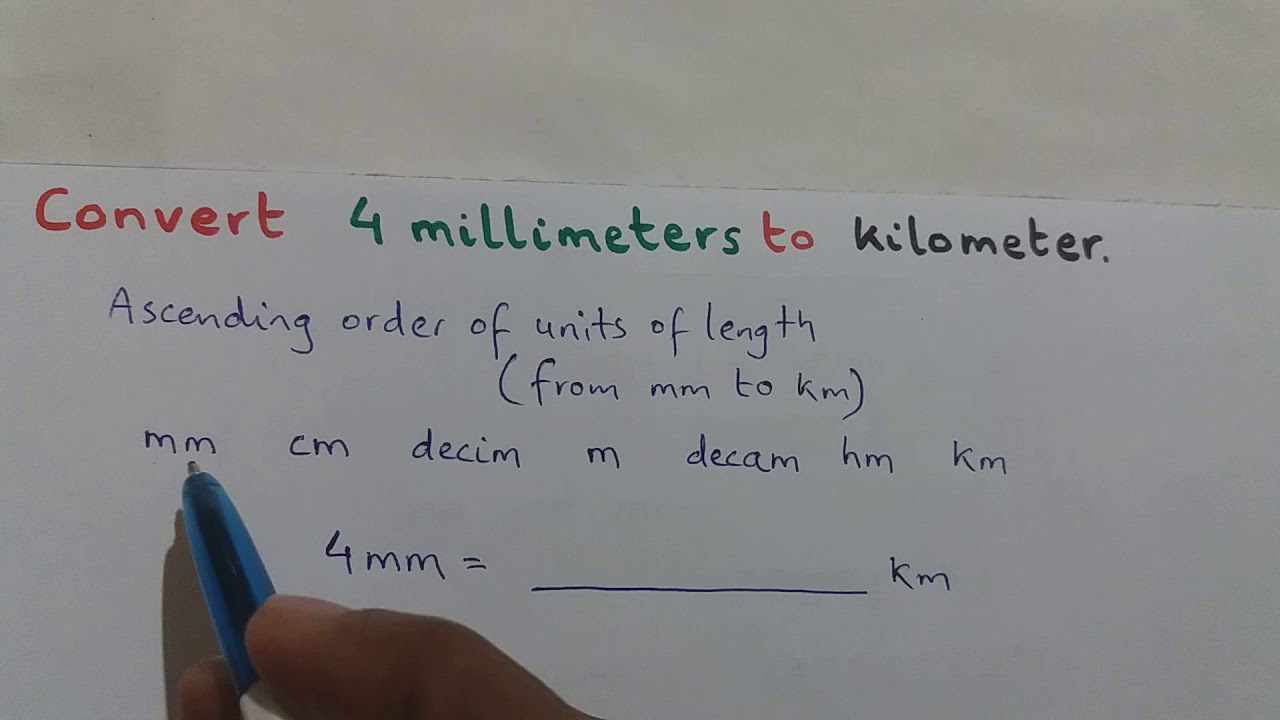
As we all know, the metric system is used worldwide for standardized measurements in various fields such as science, medicine, and engineering. Measurement conversions are essential to avoid errors in calculations and provide accurate results. One of the most commonly used units in the metric system for length or distance is kilometers (km). In this article, we will discuss the steps to convert kilometers to millimeters (mm).
What is a kilometer?
A kilometer is a unit of length in the metric system that is equal to 1000 meters. It is commonly used for longer distances like measuring the distance between cities or countries.
What is a millimeter?
A millimeter is a unit of length in the metric system that is equal to 0.001 meters. It is commonly used for smaller distances like measuring the size of bacteria or thickness of paper.
Steps to convert kilometers to millimeters
Converting kilometers to millimeters requires multiplying the value of kilometers by 1,000,000 (or 10^6) since there are 1,000,000 millimeters in a kilometer. Follow these simple steps to convert km to mm:
Step 1:
Identify the value in kilometers to be converted to millimeters.
Step 2:
Write down the conversion equation:
1 kilometer = 1,000,000 millimeters
Therefore, "x" kilometers = "y" millimeters can be expressed as x km = y mm.
Step 3:
Multiply the value in kilometers by 1,000,000.
For example, if we want to convert 5 kilometers to millimeters:
| Conversion Equation | Formula | Result |
|---|---|---|
| 5 km = ? mm | 5 km x 1,000,000 | 5,000,000 mm |
Step 4:
Write down the answer in millimeters.
Therefore, 5 kilometers is equal to 5,000,000 millimeters.
Conclusion
Converting kilometers to millimeters can be done by multiplying the value in kilometers by 1,000,000. This conversion is essential in various fields of study that require the use of the metric system. It is significant to note that when converting km to mm, there is an increase in the number of units, implying that the result would be significantly larger. It is essential to differentiate between kilometers and millimeters to avoid errors in measurements and calculations.
